Anistroph — Technical Architecture
This document describes how Anistroph separates dataset-specific prediction problems from shared services for training, prediction, explainability, evaluation, and multidimensional analysis.
New to Anistroph? See the Anistroph project overview for the architecture, capabilities, and design goals.
For installation, Claude/MCP setup, dataset configuration, and worked examples, see Setup & Usage.
Contents
- Architecture Overview
- Architectural Principles
- Dataset & Prediction Contracts
- Feature & Target Processing
- Training & Evaluation
- Runtime Architecture
- Services & Interfaces
- AI Agent Access & Cross-Interface Validation
- Persistence & Registries
- Extensibility
- Implementation Map
1. Architecture Overview
Anistroph uses dataset-specific configuration to define a prediction problem while keeping the surrounding analytical and runtime services generic.
Each registered dataset provides its own schema, features, target semantics, preprocessing, and model artifacts. Those dataset-specific contracts feed the same training, evaluation, prediction, explanation, and analytical services.
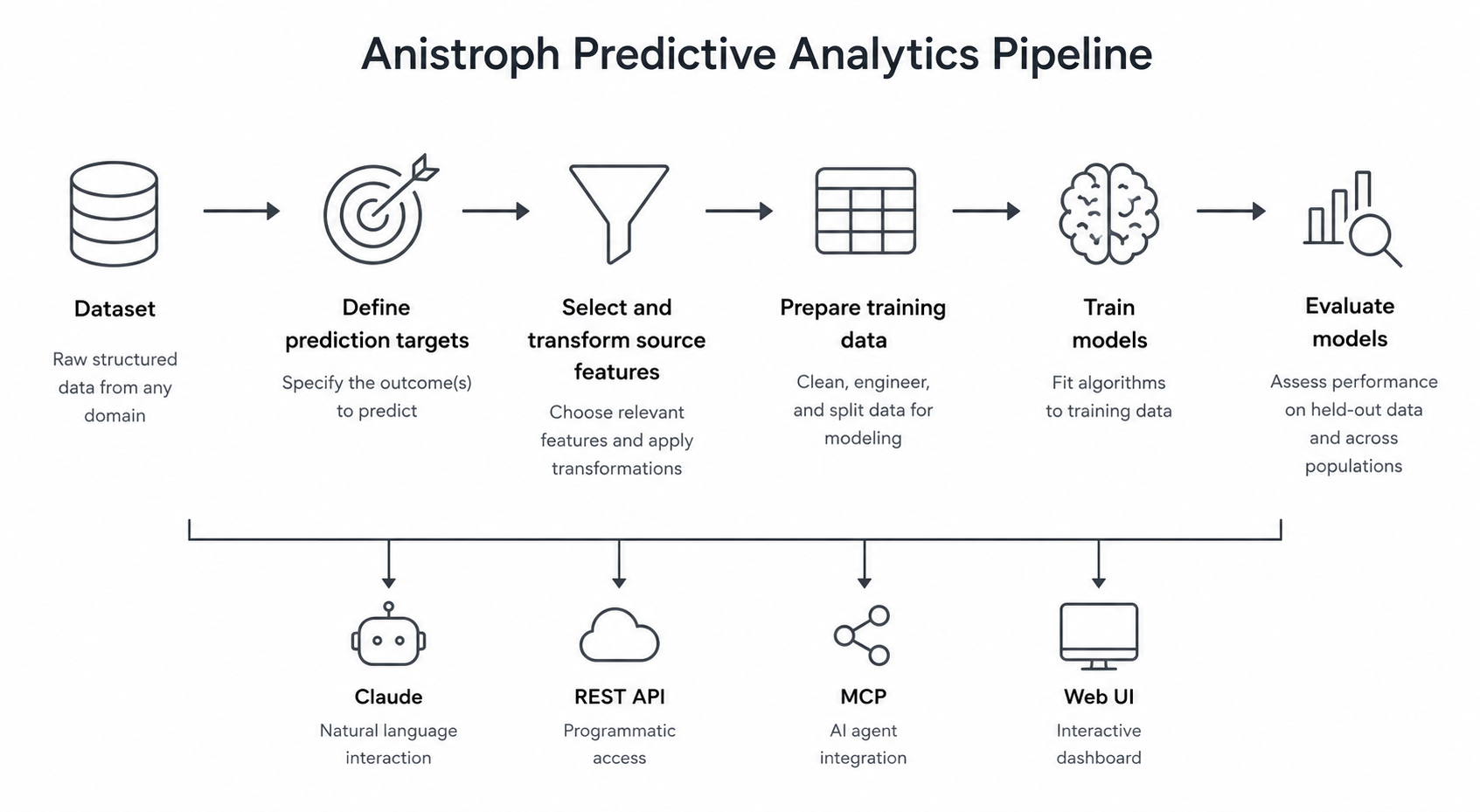
At runtime, the architecture exposes four complementary capabilities:
- Predict — run point-in-time or future predictions from source-level inputs.
- Explain — explain individual predictions, including SHAP-based explanations for XGBoost models.
- Evaluate — measure persisted-model performance on held-out data and across multidimensional populations.
- Analyze — slice, aggregate, compare, and discover patterns in observed data.
The same capabilities are available through MCP, REST/OpenAPI, and the Web UI.
2. Architectural Principles
Dataset and model isolation
Domain-specific concepts remain in dataset and prediction configuration rather than being embedded in shared runtime services. Semiconductor, maintenance, procurement, real-estate, and future datasets can therefore use the same application architecture.
Configuration-driven prediction problems
DatasetSpec, FeatureSpec, and TargetSpec define the schema, model
inputs, transforms, and prediction target. The shared pipeline
interprets these contracts rather than requiring a separate training or
inference implementation for every dataset.
Shared training and inference semantics
The same feature engine is used during training and inference. Persisted feature metadata preserves categorical encodings and feature order so runtime prediction applies the same preprocessing contract used to train the model.
Leakage-safe temporal processing
Temporal features use only observations available at the prediction point. History scans are bounded by the longest configured rolling window, and temporal datasets are split chronologically.
Shared service layer
AnistrophServices is the common application layer used by MCP, REST,
and the Web UI. Interfaces remain thin and do not implement their own
model or analytical logic.
Runtime and administrative boundaries
MCP exposes model discovery, prediction, explanation, evaluation, and analysis. Dataset registration, model training, deletion, and arbitrary Python execution remain outside the agent-facing MCP tool surface.
3. Dataset & Prediction Contracts
A prediction problem is defined by three related specifications:
DatasetSpec
    +
FeatureSpec
    +
TargetSpec
    ↓
Prediction Contract
3.1 DatasetSpec
backend/datasets/spec.py
A Pydantic model describing the source dataset, including:
dataset_identity_key- optional
time_key - column types: numeric, categorical, boolean, timestamp, string
- column roles: identifier, feature, event, target, metadata, ignore
The dataset contract defines what the source data means without prescribing a particular model.
3.2 FeatureSpec
backend/features/spec.py
Defines the source features and transformations used to construct model inputs.
Supported transforms include:
currentmeanminmaxstdmedianslopedeltacategoricalhour_of_dayday_of_weekelapsed_time
Windowed transforms accept duration strings such as 1h, 6h, or
13w.
FeatureSpec.max_history_window() derives the longest configured
history requirement. Runtime inference uses this value to limit temporal
history scans to the data actually needed to reconstruct current model
inputs.
3.3 TargetSpec
backend/targets/spec.py
Defines the outcome being predicted.
Supported target types are:
regressionclassificationbinary— legacy alias for classificationfuture_event— forward-looking boolean outcome with a time horizon
future_event targets are constructed independently per entity so an
event on one entity cannot label another.
4. Feature & Target Processing
4.1 Feature Engine
backend/features/engine.py
The feature engine interprets FeatureSpec for both training and
inference.
For categorical features, encodings are fitted during training and
persisted in FeatureMetadata. Runtime inference then applies the
identical categories and transformed feature order.
For temporal features, calculations are performed per entity and only against observations available through the prediction point.
4.2 Target Engine
backend/targets/engine.py
The target engine constructs labels according to TargetSpec.
Regression and classification targets use configured source columns,
while future_event constructs forward-looking labels within each
entity’s history.
4.3 Leakage Prevention
Anistroph keeps feature construction and target construction temporally separated:
- rolling windows are trailing and per entity;
- features never use observations after the prediction point;
- future-event targets may look forward, while features do not;
- categorical categories are learned from training data;
- temporal datasets use chronological train/evaluation splits.
This keeps the training representation aligned with what would actually be available at runtime.
5. Training & Evaluation
Training is orchestrated by backend/ml/training.py.
Registered Dataset
        │
        ▼
Build Features + Target
        │
        ▼
Train / Evaluation Split
        │
        ▼
Fit Model
        │
        ▼
Held-Out Evaluation
        │
        ▼
Persist Model + Contracts + Metrics
5.1 Model Contract
backend/ml/base.py defines the Predictor abstraction:
fitpredictpredict_probasaveloadfeature_importance
Implemented model adapters include:
backend/models/logistic.py— Logistic Regression withStandardScalerbackend/models/xgboost.py— XGBoost classifierbackend/models/xgboost_regressor.py— XGBoost regressorbackend/models/linear_regression.py— Linear/Ridge regression baseline
5.2 Held-Out Evaluation
backend/ml/evaluation.py
Classification metrics include:
- ROC-AUC
- PR-AUC
- precision
- recall
- F1
- confusion matrix
Regression metrics include:
- MAE
- MSE
- RMSE
- R²
- MAPE
- max error
Classification thresholds can be optimized for F1 on validation data.
5.3 Multidimensional Evaluation
Aggregate model metrics can hide populations where performance differs materially.
Anistroph can evaluate persisted-model error across one-, two-, and three-dimensional categorical combinations, for example:
Overall Model
     │
     ├── Product
     ├── Product × Tool
     └── Product × Tool × Chamber
This answers a different question from multidimensional data analysis:
- Analysis: where is the observed outcome unusual?
- Evaluation: where is model performance unusually good or poor?
6. Runtime Architecture
Runtime inference is implemented in backend/ml/inference.py.
Prediction accepts a model_id and either an existing entity or
source-level records. Anistroph loads the persisted model contract,
reconstructs the required features, applies the stored preprocessing,
and invokes the model.
6.1 Temporal Inference
For temporal models, inference reconstructs features from entity history using the same feature engine used during training.
Parquet is scanned lazily with predicate pushdown. The lower history boundary is derived from the model’s longest configured feature window, avoiding a full-dataset load when only recent history is required.
6.2 Explainability
backend/ml/explain.py
XGBoost models use SHAP TreeExplainer. One-hot SHAP contributions are grouped back to the original source feature so explanations remain understandable at the dataset level.
Models without TreeSHAP support use an importance-weighted fallback.
6.3 Multidimensional Analysis
backend/analysis/slice.py
The analytical engine provides deterministic operations such as:
- slice
- aggregate
- compare
- multidimensional population discovery
These operations use Polars and remain independent of model training.
7. Services & Interfaces
7.1 AnistrophServices
backend/services.py
AnistrophServices is the unified service layer powering all datasets
and interfaces.
It coordinates dataset, model, prediction, explanation, evaluation, and analytical operations behind a common application boundary.
Claude / AI Agents       Applications          Web UI
        │                     │                  │
       MCP                 REST API              │
        │                     │                  │
        └──────────────┬──────┴──────────────────┘
                       ▼
                AnistrophServices
                       │
        Dataset • Model • Prediction
       Explanation • Evaluation • Analysis
7.2 MCP
backend/integrations/mcp/
Two MCP transports call the same service layer:
- stdio — local subprocess transport used by Claude Desktop and other local MCP clients.
- Streamable HTTP —
/mcpendpoint on the FastAPI server for remote MCP clients.
The MCP layer does not expose arbitrary Python execution or model training.
7.3 REST / OpenAPI
backend/main.py, backend/api/
FastAPI routers expose datasets, analysis, models, predictions,
explanations, evaluation, and administrative operations. Routes delegate
to AnistrophServices.
7.4 Web UI
frontend/index.html
The Web UI provides dataset, analysis, training, model, and prediction workspaces and adapts to registered dataset specifications.
8. AI Agent Access & Cross-Interface Validation
Claude and other AI agents can use MCP to discover datasets and models, inspect model input requirements, run predictions, explain results, evaluate model performance, and perform multidimensional analysis.
The agent is an orchestration and interaction layer; model execution and analytical operations remain inside Anistroph.
Because MCP, REST, and the Web UI invoke the same AnistrophServices
layer, an agent-generated operation can be reproduced through another
interface using the same model and inputs.
Claude / AI Agent
       │
       ▼
Discover Model + Input Contract
       │
       ▼
Predict • Explain • Evaluate • Analyze
       │
       ▼
AnistrophServices
       │
       ▼
Persisted Model + Dataset
       │
       ├──────── MCP
       ├──────── REST / OpenAPI
       └──────── Web UI
This provides cross-interface validation without creating separate execution paths for agent-driven analysis.
9. Persistence & Registries
9.1 Data Storage
Registered dataset data is persisted primarily as Parquet.
9.2 Dataset Registry
artifacts/dataset_registry.json
DatasetRegistry stores lightweight dataset metadata independently of
the Parquet files.
9.3 Model Artifacts
Persisted model artifacts are stored under:
artifacts/models/<model_id>/
    model.joblib
    imputer.joblib
    metadata.json
    feature_spec.json
    feature_metadata.json
    target_spec.json
    metrics.json
artifacts/models/model_index.json provides the model metadata index.
Together, the model artifact and persisted specifications preserve the model, preprocessing contract, feature metadata, target definition, and evaluation results required for runtime use.
10. Extensibility
Anistroph is designed so new prediction problems extend defined architectural boundaries rather than requiring changes throughout the system.
| Extension | Architecture point |
|---|---|
| New dataset or domain | DatasetSpec + FeatureSpec + TargetSpec |
| New target against existing data | New target/configuration |
| New target semantics | TargetSpec + target engine |
| New model family | Predictor model adapter |
| New explanation method | Explanation layer |
| New analytical operation | Analysis service |
| New REST/UI interface capability | AnistrophServices |
| New MCP capability | MCP tool over an existing service operation |
The current architecture supports regression and binary classification. Additional task types and model families can be introduced behind the same contracts.
11. Implementation Map
backend/
├── datasets/
│   ├── spec.py             DatasetSpec
│   └── ...                 Dataset registry and loading
├── features/
│   ├── spec.py             FeatureSpec
│   └── engine.py           Shared feature construction
├── targets/
│   ├── spec.py             TargetSpec
│   └── engine.py           Target construction
├── ml/
│   ├── base.py             Predictor contract
│   ├── training.py         Training pipeline
│   ├── evaluation.py       Model evaluation
│   ├── inference.py        Runtime prediction
│   ├── explain.py          Explanation layer
│   └── registry.py         Model artifact store
├── models/
│   ├── logistic.py
│   ├── xgboost.py
│   ├── xgboost_regressor.py
│   └── linear_regression.py
├── analysis/
│   └── slice.py            Multidimensional analysis
├── integrations/
│   └── mcp/                MCP transports and tools
├── api/                    REST routers
├── main.py                 FastAPI application
└── services.py             Shared application service layer

frontend/
└── index.html              Web UI

artifacts/
├── dataset_registry.json
└── models/
    ├── model_index.json
    └── <model_id>/         Persisted model artifacts
The implementation map is intentionally secondary to the architecture: source-code modules implement the contracts and service boundaries described above rather than defining the architecture themselves.
Testing
The test suite (69 tests) covers unit-level component correctness and integration-level interface parity. Tests run against synthetic data generated in fixtures, so they are deterministic and do not depend on registered datasets or trained models from a prior session.
Test layout
| File | Tests | Scope |
|---|---|---|
tests/unit/test_datasets.py |
14 | Config loading, column type/role parsing, split config, validation (missing columns, null entity keys), CSV/Parquet ingestion, profiling, registry register/retrieve/list |
tests/unit/test_features.py |
8 | Feature engine: shape after building, one-hot encoding, leakage-safe rolling mean, metadata persistence, train-inference metadata reuse, current and slope transforms, no domain assumptions in engine |
tests/unit/test_ml.py |
23 | Chronological/random splitting, binary evaluation (ROC-AUC, PR-AUC, F1), best-threshold selection, model save/load (logistic, XGBoost), feature importance, training pipeline (train, persist, reload, predict), train-inference feature parity, SHAP explanation, task type auto-selection, target type properties |
tests/unit/test_partitioning.py |
12 | Split percentage resolution (YAML overrides .env), temporal→chronological, non-temporal→random, three-way splits, empty partition schema preservation, percentage normalization, persist (skip empty, all-empty), partition summary |
tests/unit/test_search.py |
28 | Parametric search: all operators (eq, in, gte, lte, between, contains_range), semantic filter expansion (range_contains, expands_to), unknown field/semantic errors, AND-combination, limit cap, sort, columns subset, applied_filters audit, search contract enrichment with profile |
tests/unit/test_semiconductor.py |
37 | End-to-end on semiconductor dataset: data integrity (row count, value ranges, required columns, hidden interactions), config validation, regression evaluation, model adapters (XGBoost regressor, linear regression), training (beats baseline, chronological split, persist/reload), filtered evaluation, interesting slices (finds ETCH_02/CH_B), SHAP explainability (sign correctness, contributions sum to prediction, one-hot grouping, backward compat) |
tests/unit/test_targets.py |
6 | Future event target construction (column exists, positive labels, entity isolation, horizon boundary, no future leakage), binary target construction |
tests/integration/test_api.py |
41 | REST endpoints: health, datasets (list, get, profile), analysis (slice, compare), models (train, auto-select, delete), prediction, explanation, evaluation (regression, classification, filtered, unknown filter, error slices, pct error), parametric search (contract, 3 acceptance queries, sort, columns, errors), predict-on-search (classification, regression, semantic filter, unknown model, no matches), external integrations (list tools, invoke with validation, unknown tool, mocked A2A) |
tests/integration/test_mcp.py |
37 | MCP tool surface: tool discovery + schema validation, all 17 tools (16 native + 1 external A2A), external tool discovery, schema, validation error, unresolved URL, invalid tool/input handling |
tests/integration/test_e2e.py |
2 | Full lifecycle (register → train → predict → explain → evaluate) and REST-MCP service parity (both interfaces hit the same underlying services) |
Coverage by purpose
| Purpose | Tests | What it prevents |
|---|---|---|
| Leakage prevention | ~8 | Future data in rolling windows, cross-entity contamination, non-chronological splits on temporal data |
| Train-inference feature parity | ~5 | Features built differently at inference than training (silent prediction drift) |
| SHAP explainability | ~12 | Incorrect impact signs, ungrouped one-hot columns, contributions not summing to prediction |
| Evaluation & error slices | ~12 | Wrong metrics, missing filtered metrics, slice discovery returning unranked or unfiltered results |
| API/MCP surface coverage | ~45 | Any endpoint or tool breaking silently after a change |
| Data integrity | ~10 | Missing columns, out-of-range values, absent hidden interactions that models depend on |
| Partitioning | ~12 | Overlapping train/eval, empty partitions crashing the pipeline, wrong split percentages |
| Config/validation | ~14 | Malformed YAML, missing columns, null entity keys, invalid column types |
| Model adapters | ~10 | Save/load failures, wrong task type mapping, fit/predict mismatches |
Running the tests
# Full suite
pytest tests/ -q

# Unit only
pytest tests/unit/ -q

# Integration only
pytest tests/integration/ -q