Anistroph
Multi-Domain Predictive Analytics with AI Agent Access
What does it look like when an AI agent can discover predictive models, understand how to use them, run predictions, explain results, and analyze the underlying data?
Anistroph through Claude
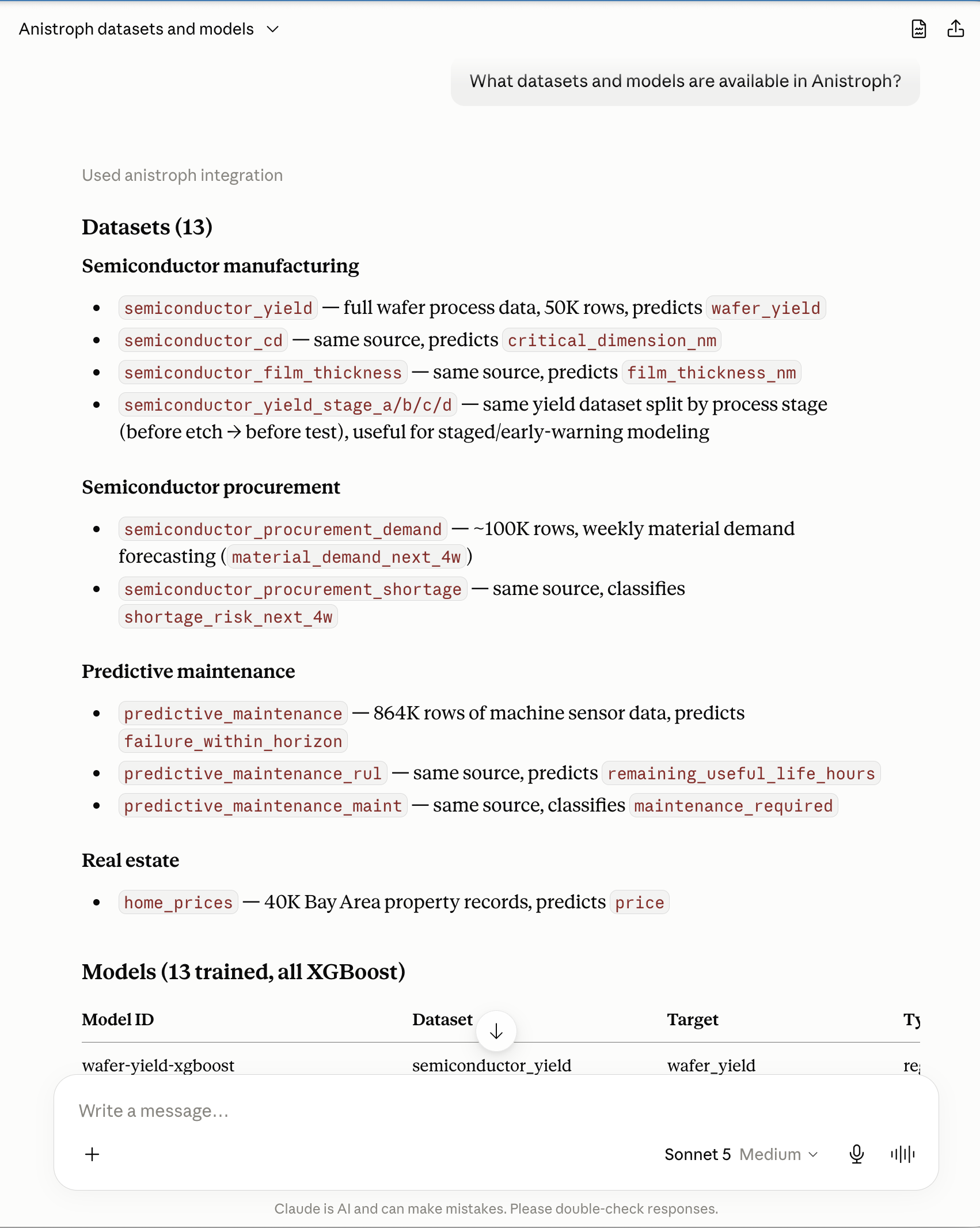
What datasets and models are available in Anistroph?
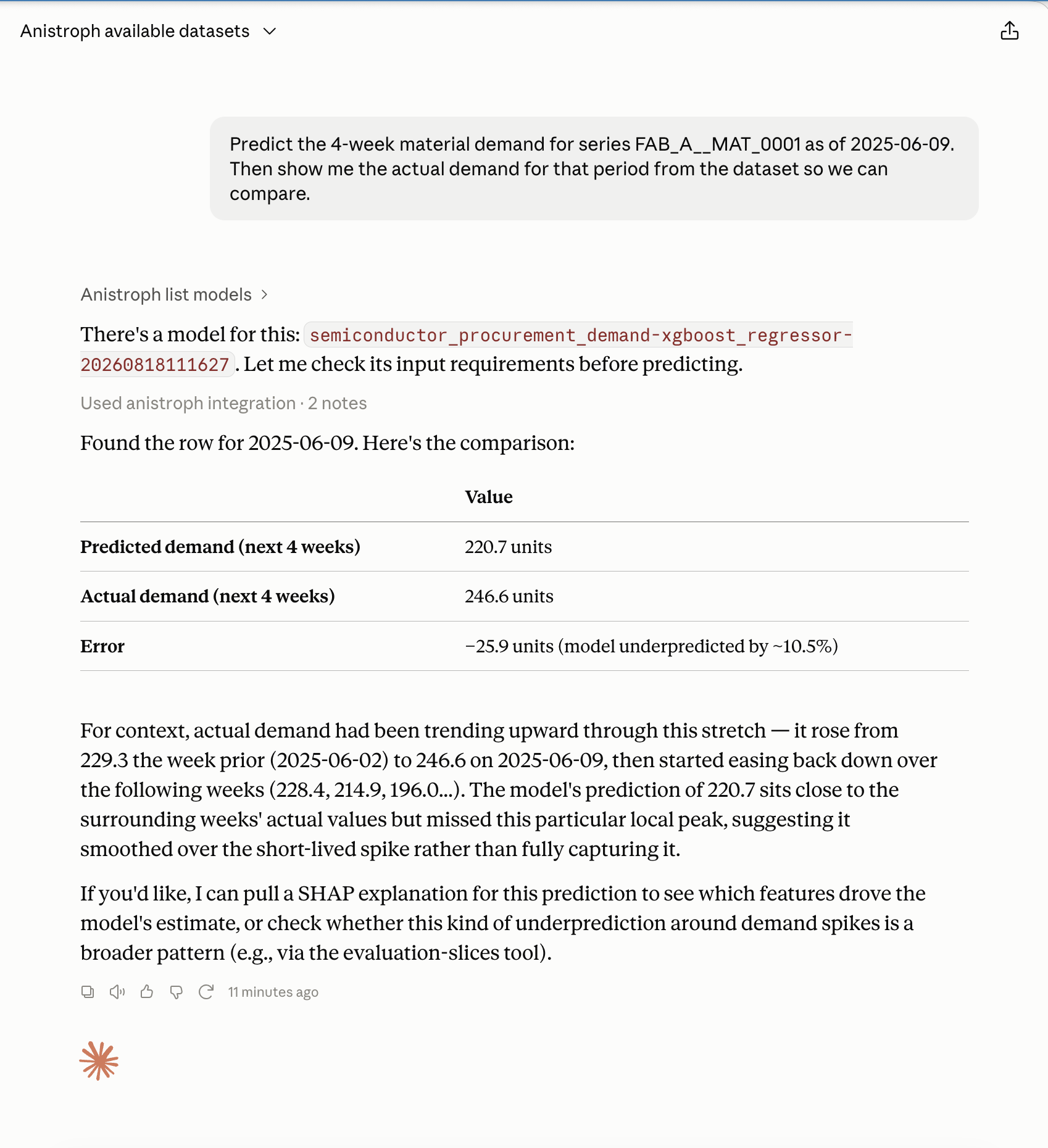
Predict the 4-week material demand for `FAB_A__MAT_0001` as of `2026-07-06`. Then show me the actual demand so we can compare.
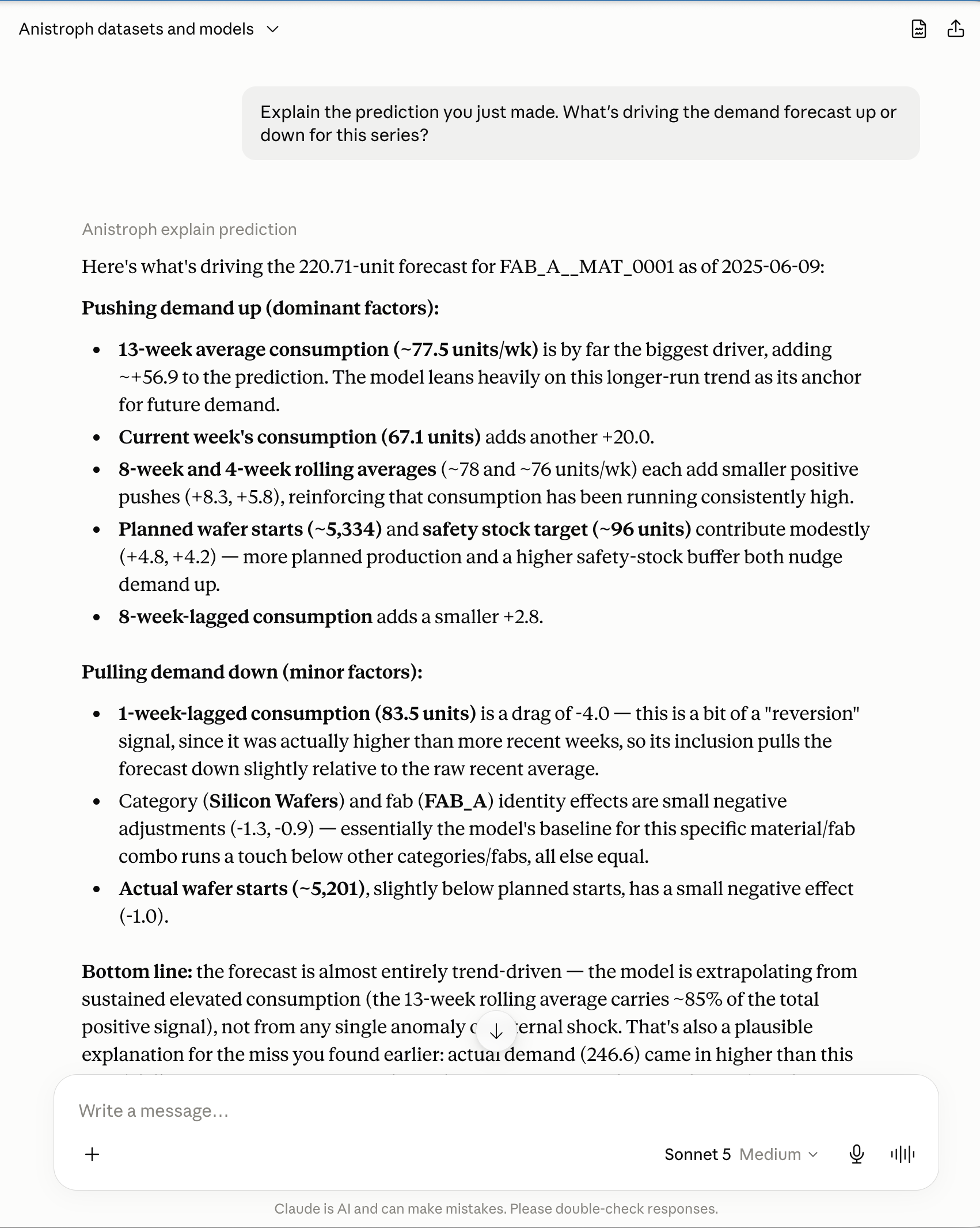
Explain the prediction. What's driving the demand forecast up or down?
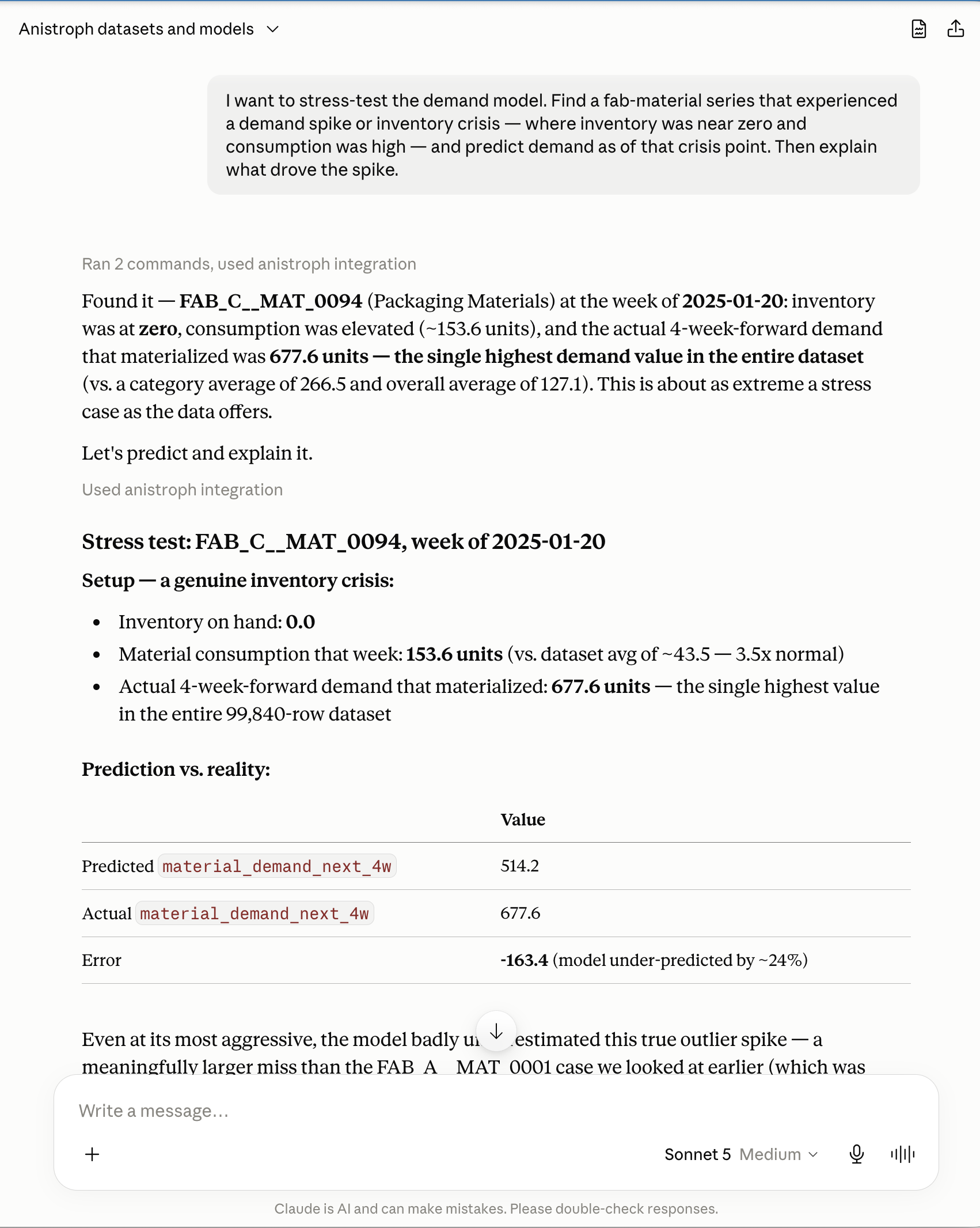
Find a fab-material series that experienced a demand spike or inventory crisis, predict demand at that point, and explain what drove the spike.
Discovering datasets and models
|
Predicting material demand
|
Explaining the prediction with SHAP
|
Stress-testing a real inventory crisis
|
MCP access: Anistroph includes an MCP server that can run locally or be deployed with the application. Users can connect Claude and other MCP-compatible clients to their own Anistroph environment through stdio or Streamable HTTP.
Behind the Queries
Anistroph is a multi-domain predictive analytics architecture for structured data — connecting dataset-specific models to shared prediction, explainability, evaluation, multidimensional analysis, and AI-agent services.
Different domains can have different schemas, features, targets, preprocessing, and models without rebuilding the surrounding analytics stack.
A semiconductor manufacturing team can predict wafer yield at different process stages. A maintenance team can predict equipment failure and remaining useful life. A procurement team can forecast material demand and shortage risk. Each problem is different, but all use the same Anistroph runtime.
Explore: GitHub · Setup & Usage · Technical Architecture
Predictive Use Cases
Anistroph includes synthetic reference implementations designed to exercise different parts of the architecture.
| Reference domain | Predictive use cases | What it demonstrates |
|---|---|---|
| Semiconductor Manufacturing | Wafer yield, critical dimension, film thickness | Multiple targets, process-stage prediction, SHAP explainability, multidimensional evaluation |
| Predictive Maintenance | Equipment failure, remaining useful life, maintenance required | Temporal sensor data, classification + regression, history-based features |
| Semiconductor Materials Procurement | 4-week material demand, 4-week shortage risk | Rolling forecasts, temporal prediction, inventory/supplier signals, multidimensional analysis |
| Semiconductor Memory | Parametric product search, supply risk prediction | Structured catalog filtering, semantic filters (range-containment), self-describing search contract, predict-on-search ranking by supply risk / lead time |
| Real estate | Home price prediction | Lightweight cross-domain regression validation |
The reference datasets are not intended as production benchmarks. They provide concrete, reproducible problems for demonstrating how the same architecture behaves across different predictive domains.
Trained Reference Models
Held-out evaluation metrics for the shipped reference models:
| Domain | Target | Task | Held-out metric |
|---|---|---|---|
| Semiconductor Yield | wafer_yield |
Regression | R² = 0.81 |
| Semiconductor CD | critical_dimension_nm |
Regression | R² = 0.89 |
| Semiconductor Film Thickness | film_thickness_nm |
Regression | R² = 0.98 |
| Predictive Maintenance — Failure | failure_within_horizon |
Classification | ROC-AUC = 0.85, F1 = 0.61 |
| Predictive Maintenance — Maintenance | maintenance_required |
Classification | ROC-AUC = 1.00, F1 = 0.94 |
| Predictive Maintenance — RUL | remaining_useful_life_hours |
Regression | MAE = 27.9h |
| Home Prices | price |
Regression | R² = 0.97 |
| Procurement — Demand | material_demand_next_4w |
Regression | R² = 0.96, MAE = 14.0 |
| Procurement — Shortage Risk | shortage_risk_next_4w |
Classification | ROC-AUC = 0.99, F1 = 0.90 |
| Memory Supply Risk | supply_risk_next_4w |
Classification | ROC-AUC = 0.999, F1 = 0.979 |
| Memory Supply Lead Time | lead_time_next_4w_days |
Regression | R² = 0.996, MAE = 1.1d |
Models are trained on the train partition and evaluated on the held-out evaluation partition (most recent 20% for temporal datasets, random 20% for non-temporal). The two never overlap.
Note: These metrics are from synthetic reference datasets designed to exercise Anistroph’s architecture and workflows; they are not benchmarks of expected real-world model performance.
For dataset-specific prompts and worked examples, see the Setup & Usage Guide.
Core Features
- Multi-Domain Predictive Runtime — Different datasets retain their own schemas, features, targets, preprocessing, and models while sharing prediction, explanation, evaluation, and analysis services.
- AI Agent Access through MCP — Claude and other MCP-compatible agents can discover datasets and models, inspect model contracts, and invoke prediction, explanation, evaluation, and analysis through stdio or Streamable HTTP.
- Self-Describing Models — Model contracts expose required
inputs, prediction mode, and temporal requirements such as
as_ofand inference history. - Temporal & Records-Based Prediction — Supports direct source-record inference and temporal entity lookup with rolling feature reconstruction from historical data.
- Multiple Targets & Process Stages — A source dataset can support different prediction targets and task types, or models for the same target at different process stages.
- SHAP Explainability & One-Hot Feature Normalization — Maps SHAP contributions from one-hot encoded features back to their original source features and values.
- Multidimensional Analysis & Evaluation — Analyzes observed outcomes and model performance across 1-, 2-, and 3-dimensional populations.
- Cross-Interface Validation — MCP, REST/OpenAPI, and the Web UI use the same shared runtime, allowing agent-driven operations to be independently reproduced and validated.
- Parametric Search — Datasets can declare a structured search contract with searchable fields, units, aliases, and semantic filters (e.g. “supports 55°C” → range-containment). Agents discover the contract, normalize natural-language requirements, and apply deterministic filters via the same shared service layer.
- External A2A Integration — Anistroph can hand off context to externally-hosted AI agents (e.g. Aina-Veris for datasheet RAG) via A2A JSON-RPC. External tools are defined in a tool registry and exposed through both MCP and REST. Aina-Veris is used as the reference implementation but is not a hard dependency — any A2A-compatible system can be configured.
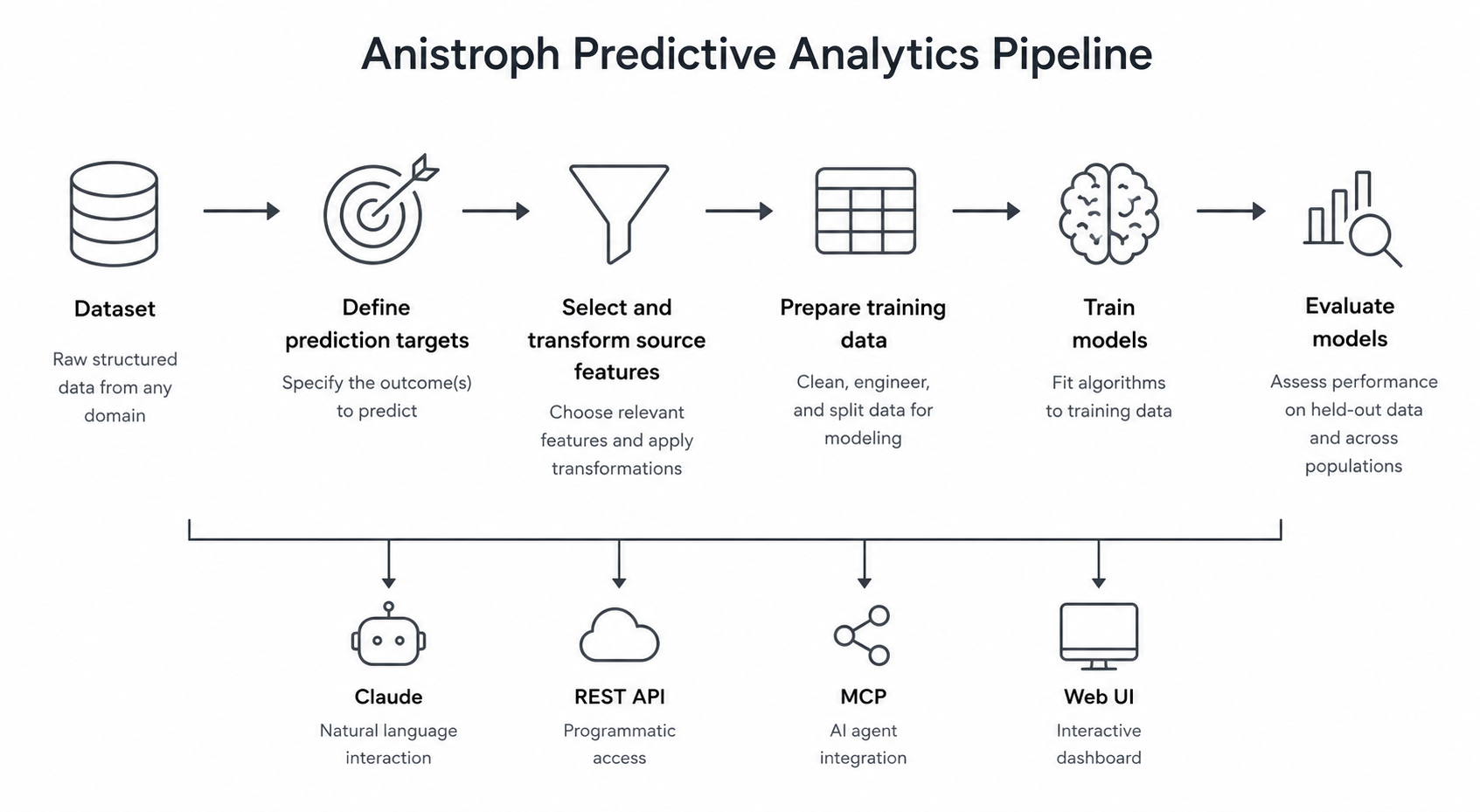
The Anistroph predictive analytics pipeline — from dataset configuration through shared services to MCP, REST, and Web UI interfaces.
AI Agents as an Interface to Predictive Analytics
Anistroph exposes predictive and analytical capabilities to Claude and other AI agents through MCP stdio and Streamable HTTP.
User
 │
 ▼
Claude / AI Agent
 │
 ├── Discover datasets and models
 ├── Inspect model input requirements
 ├── Predict and explain
 ├── Evaluate model performance
 └── Analyze multidimensional populations
 │
 ▼
Anistroph Shared Runtime
 │
 ├── Registered Datasets
 ├── Feature / Preprocessing Contracts
 └── Persisted Models
Agents operate against the same runtime used by REST/OpenAPI and the Web UI rather than implementing their own prediction or analytical logic.
AI Agent Analysis & Validation
Discover → Understand → Execute → Validate
Claude and AI agents first discover the available datasets and models, then inspect the selected model’s input contract to determine required inputs, temporal requirements such as as_of, and required inference history.
The agent can then orchestrate prediction, explanation, evaluation, and analysis through MCP. These operations are executed by Anistroph’s shared services and can be independently reproduced through the Web UI or REST API when validation is required.
This makes the source-feature inputs, selected model, and analytical operation portable across interfaces. An agent-driven workflow can therefore be inspected or reproduced independently without changing the underlying model execution path.
One Architecture, Different Prediction Problems
Multi-Domain Datasets
Each dataset retains its own schema, features, targets, preprocessing, and model artifacts. Shared services remain independent of semiconductor, maintenance, procurement, real estate, or future domain concepts.
Semiconductor ──→ Yield / CD / Film Models ──────┐
Maintenance ────→ Failure / RUL Models ──────────┤
Procurement ────→ Demand / Shortage Models ──────┼─→ Shared Runtime
Real Estate ────→ Price Model ───────────────────┤
Future Domains ─→ Domain-Specific Models ────────┘
                                                   │
                                  Predict • Explain • Evaluate • Analyze
                                                   │
                                      MCP • REST/OpenAPI • Web UI
Declarative Dataset and Model Contracts
Dataset YAML defines what is unique to a prediction problem:
- source schema and identifiers;
- model input features and transforms;
- prediction target and task type;
- temporal semantics where applicable;
- train/evaluation split strategy.
The shared services consume these contracts rather than embedding
domain-specific rules into the runtime. To add your own dataset, author
a dataset.yaml and register it — see Adding a
Dataset in the
README and the Dataset Configuration
reference in the Setup & Usage
Guide for the full YAML schema, transform table, and worked examples.
Multiple Targets
One source dataset can support independent predictive outcomes. Semiconductor manufacturing, for example, uses separate models for wafer yield, critical dimension, and film thickness while sharing the same underlying source data.
Process-Stage Prediction
Anistroph can train separate models for different points in a process using only the information available at each stage.
Before Etch ──→ After Etch ──→ Deposition / Lithography ──→ Final Test
     │               │                         │
     ▼               ▼                         ▼
 Early Model     Mid-Process Model        Later-Stage Model
This supports progressively better-informed predictions without introducing future-process information into earlier-stage models.
Temporal Prediction
Temporal prediction separates the trained model from the changing history used to construct its current inputs.
Entity History through as_of
            │
            ▼
   Rolling / Current Features
            │
            ▼
      Persisted Model
            │
            ▼
       Future Outcome
The longest configured rolling window determines how much entity history is needed. The forecast target determines what future period is being predicted.
Source-Level Explainability
Model preprocessing can expand one business/source feature into several engineered model features. Anistroph normalizes explanation output back to the original source feature so users and agents do not need to reason about one-hot encoded columns.
Multidimensional Analysis and Evaluation
Anistroph distinguishes between two related questions:
- Where is the outcome unusual? — multidimensional analysis of observed data.
- Where is the model unusually good or bad? — multidimensional evaluation of held-out prediction error.
For example, a wafer-yield model can be evaluated overall and then
across Product, Product × Tool, and Product × Tool × Chamber
populations.
How the System Fits Together
Each dataset follows a common predictive lifecycle:
Dataset → define prediction targets → select and transform source features → prepare training data → train models → evaluate persisted models
Once trained, models enter the shared runtime:
Dataset-Specific Layer
Schema • Features • Target • Preprocessing • Model
                         │
                         ▼
                  SHARED RUNTIME
          Predict • Explain • Evaluate • Analyze
                         │
          ┌──────────────┼───────────────┐
          ▼              ▼               ▼
         MCP        REST / OpenAPI      Web UI
          │
   Claude / AI Agents
The separation allows new datasets and models to be introduced without rebuilding the runtime services or agent interfaces.
For Developers
Anistroph is implemented as a modular Python architecture with thin interfaces over a shared service layer.
| Layer | Technology | Role |
|---|---|---|
| Language | Python | Core services, data preparation, ML orchestration |
| API / Service | FastAPI + Uvicorn | REST/OpenAPI and Web UI service layer |
| Data processing | Polars + DuckDB | Columnar transformations, querying, analytical slicing |
| Persistence | Parquet | Dataset and partition storage |
| Configuration | YAML | Dataset schemas, features, targets, and split strategy |
| ML | XGBoost + scikit-learn | Regression and classification models |
| Explainability | SHAP TreeExplainer | Per-prediction XGBoost explanations |
| Model artifacts | joblib | Model persistence and reload |
| Agent access | MCP SDK | Domain-agnostic tools over stdio and Streamable HTTP |
| Testing | pytest | Unit, integration, MCP, and end-to-end coverage |
No database, message queue, or vector store is required by the current reference implementation.
Runtime Interfaces
- MCP — 16 native tools + 1 external A2A tool (17 total) for dataset/model discovery, prediction, explanation, evaluation, analysis, parametric search, predict-on-search ranking, and external A2A agent invocation (Aina-Veris).
- REST / OpenAPI — programmatic access to runtime and administrative capabilities.
- Web UI — exploration, model interaction, and cross-interface validation.
- Python services — direct access to the shared application layer.
Training and dataset administration are intentionally excluded from the MCP agent tool surface.
External A2A Integration
For this reference implementation, Aina-Veris is used as the technical research system. The relevant datasheets and technical documents are uploaded and indexed into its semiconductor knowledge domain, providing domain-specific retrieval, grounded responses and source citations.
Aina-Veris is not a dependency of Anistroph. Another RAG or technical-document research system can be used instead, provided it exposes an interface that Anistroph can invoke, such as MCP or A2A. The external system and endpoint are configured through Anistroph’s external tool registry.
Extending Anistroph
The architecture is designed to extend along several dimensions:
- add structured datasets from new domains;
- define additional prediction targets against an existing source dataset;
- add model adapters and task types;
- introduce new model-specific explainability methods;
- add additional process-stage models;
- extend agent and application interfaces while retaining the shared runtime.
The current implementation supports regression and binary classification. Multiclass classification, specialized forecasting models, anomaly detection, model versioning/promotion, and monitoring/drift detection are natural extension paths.
Explore the Project
- GitHub Repository — source, releases, tests, and full README
- Guided Walkthrough — step-by-step inference lifecycle across three datasets (regression + classification, temporal + non-temporal)
- Setup & Usage Guide — Claude/MCP usage, dataset configuration, temporal prediction, operations, examples, and API reference
- Technical Architecture — deeper implementation and architecture details
- Full README — install, features, temporal prediction, extending, tests
- Release Notes — version history
- Story on Medium — design narrative and architecture walkthrough
- MCP market listing — MCP marketplace listing
- Designing Composable AI Systems — composable AI systems design
License
Anistroph is available under the GNU GPLv3.
Commercial licensing is also available — ai-musings99@gmail.com